Beyond the Algorithm: Human Adoption as the Prerequisite for Technological ROI

Executive Summary
Massive investments in digital infrastructure and artificial intelligence models are currently translating neither into margin gains nor GDP growth. The critical constraint weighing on the economy is no longer the availability of hardware, but the lack of managerial engineering capable of ensuring its operational adoption.
1. The Illusion of Spontaneous Returns and the Adoption Wall
The productive economy faces a major asymmetry: while the deployment of technological architectures is accelerating at an unprecedented pace, value creation remains stagnant. The assumption that introducing a high-performing technological tool automatically generates a return on investment violently collides with reality on the ground. Recent empirical data demonstrates the systemic inefficiency of purely material investments disconnected from human engineering:
- Despite $40 billion injected into professional generative AI applications globally, 95% of companies report absolutely no measurable impact on their profitability (Challapally, Pease, Raskar, & Chari, 2025).
- This inertia is echoed at the macroeconomic level, with nearly 89% of executives reporting a total absence of effect on labor productivity within their organizations (Yotzov et al., 2026).
- Operationally, the perception is equally stark: only 12% of employees working in technologically equipped environments feel that technology has truly transformed or facilitated their daily work (Gallup, 2026).
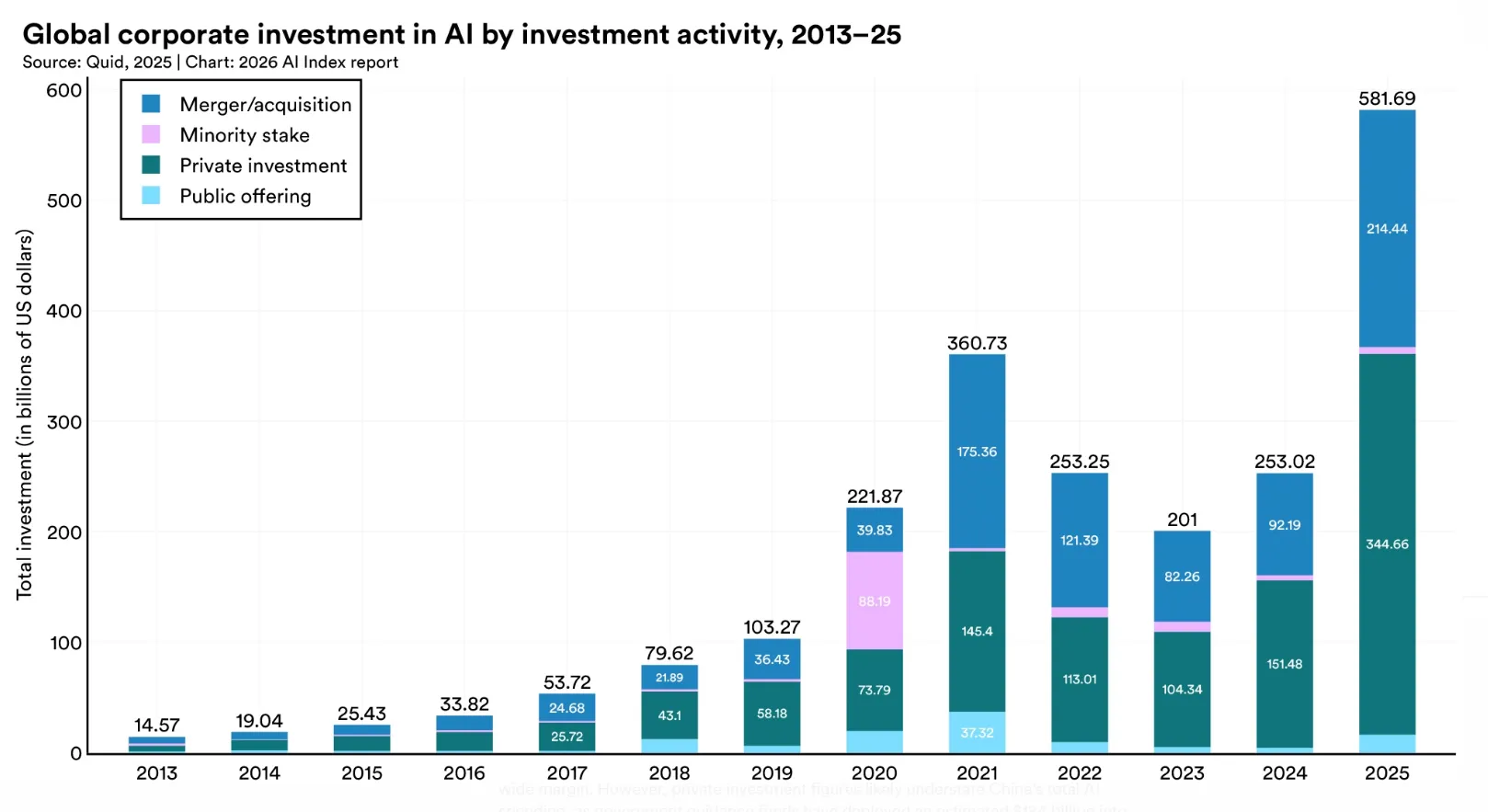 Source: Stanford HAI (2026)
The strategic conclusion is clear: the limiting constraint has definitively shifted. It no longer lies in the computational power of algorithmic models, but in the intrinsic ability of organizations to integrate them (OpenAI, cited in Gallup, 2026). Adoption is no longer a natural byproduct of innovation; it is the critical variable dictating the viability of the technological leap.
2. The Looming Cost Shock and Systemic Infrastructure Risk
This stagnant productivity masks an imminent financial peril for the economic fabric. Currently, the cost of accessing and using AI is artificially compressed. It is heavily subsidized by infrastructure providers who, driven by a monopolistic market-capture logic, are deploying aggressive acquisition strategies, sometimes operating at a loss.
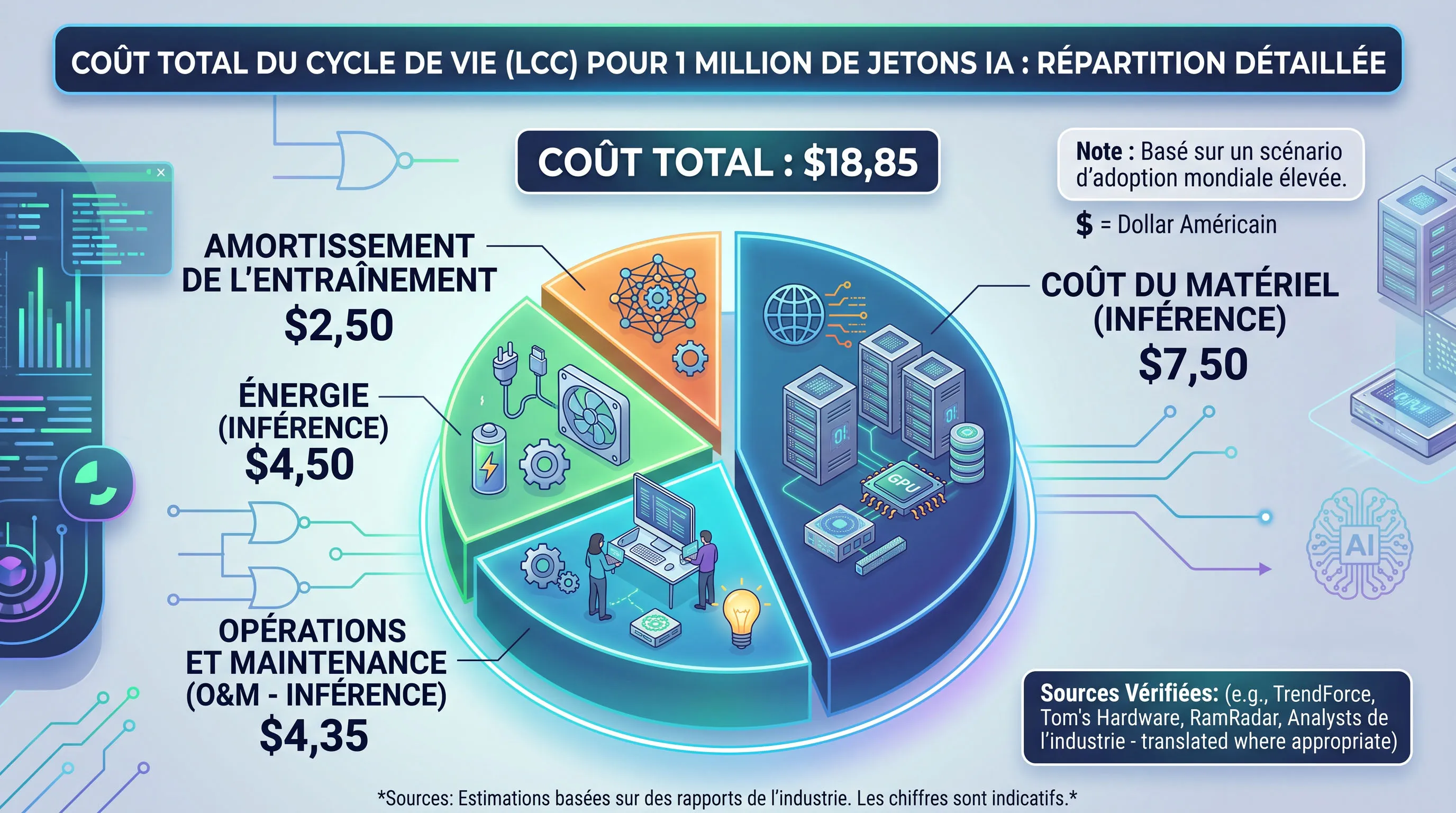
However, the physical reality of these technological architectures is unforgiving. The data centers required for training and inference demand extraordinary energy intensity, exerting critical pressure on supply grids. Compounding this is a chronic structural strain on the hardware supply chain, notably advanced silicon chips and high-density memory.
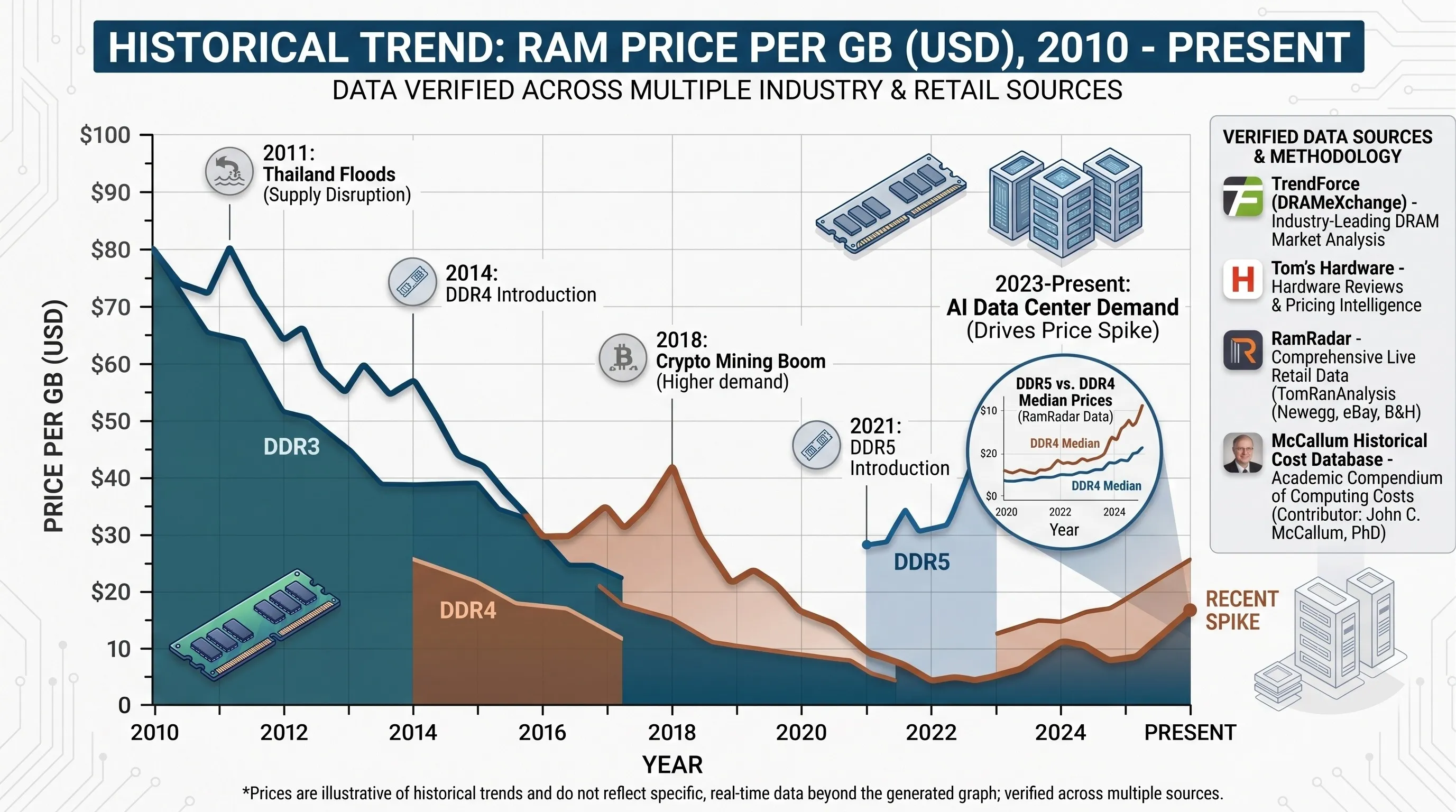
This decoupling between actual production costs and market pricing is inherently temporary. As soon as tech players pass the reality of these physical constraints onto the end customer, the lack of operational productivity gains will turn AI into a value-destroying cost center. If companies have not previously optimized their internal processes so that technology genuinely enhances human output, this future price shock will severely erode competitiveness.
3. Escaping the Zero-Sum Game: The Failure of the Hierarchical Paradigm
Faced with this efficiency wall, macroeconomic debates frequently stray into purely redistributive policies. Mandating widespread administrative wage increases without prior improvement in underlying productivity is a dangerous macroeconomic illusion. This approach simply slices a stagnant economic pie into thinner pieces, compressing margins and mechanically driving inflation higher than nominal wage gains, thereby canceling out any real purchasing power improvements.
The true adjustment variable—the only one capable of generating endogenous growth—lies in organizational efficiency. Viewed as an intangible technology in its own right, managerial practices alone account for nearly 30% of variations in total factor productivity (Bloom, Sadun, & Van Reenen, 2016).
Yet, the productive fabric is heavily penalized by a dysfunctional governance model. Companies remain too often constrained by a strict, archaic dichotomy between prescriptive command and a purely executing base. This fracture reproduces a sterile Hegelian dialectic: the labor relationship freezes into a power struggle and mutual distrust, preventing any joint problem-solving. The aviation industry once faced and resolved this structural peril: confronted with systemic accidents caused by a steep hierarchical gradient that prevented co-pilots from reporting errors, it mandated Crew Resource Management (CRM) to restore psychological safety and collective efficiency (Bienefeld & Grote, 2012; Helmreich et al., 1999).
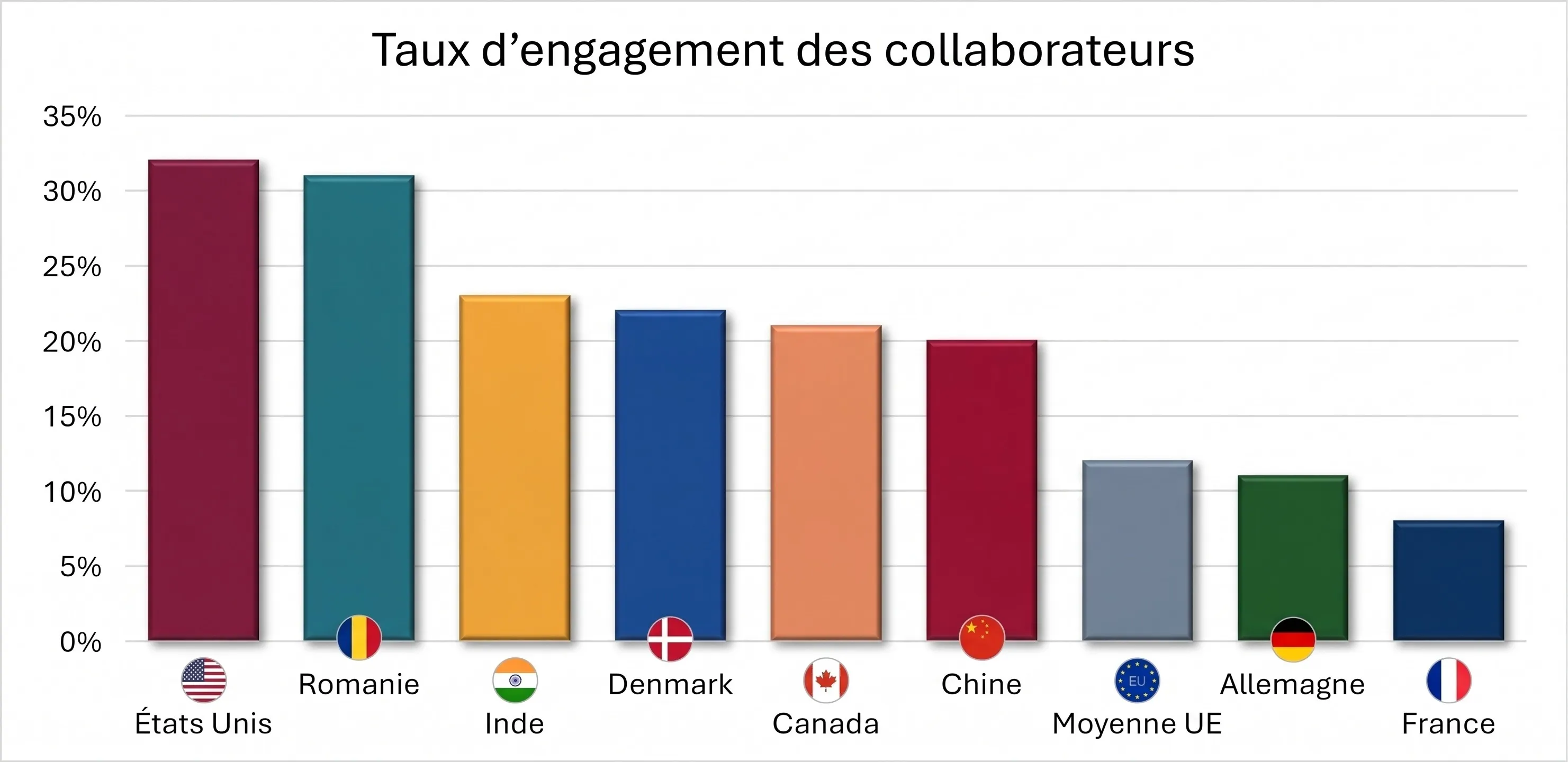
Deprived of such social engineering, the workplace collapses in global engagement rankings:
- United States and Canada: 31% engagement, supported by decentralized initiatives (Gallup, 2026).
- East Asia: 18% engagement, demonstrating strong structural resilience (Gallup, 2026).
- European average: trailing the world with only 12% engagement (Gallup, 2026).
- France: plunging to 8% engagement, a critical figure worsened by 72% passive disengagement (quiet quitting) and 20% active disengagement, synonymous with value destruction (Gallup, 2026).
4. Technostress and Modeling the Untapped Macroeconomic Reserve
This endemic disengagement is not merely a social climate indicator; it is the primary rejection filter for innovation. Integrating AI is not a simple software update; it triggers acute technostress and a genuine identity threat for employees whose historical skills are suddenly questioned, echoing the psychological upheavals of the First Industrial Revolution. A passively disengaged employee will never deploy the cognitive load required to master this anxiety and adapt their processes to the machine; they will merely endure the tool or find ways around it.
Systematically resolving this failure offers an exceptional wealth reserve:
- Globally, this disengagement costs approximately 9% of global GDP (Gallup, 2026).
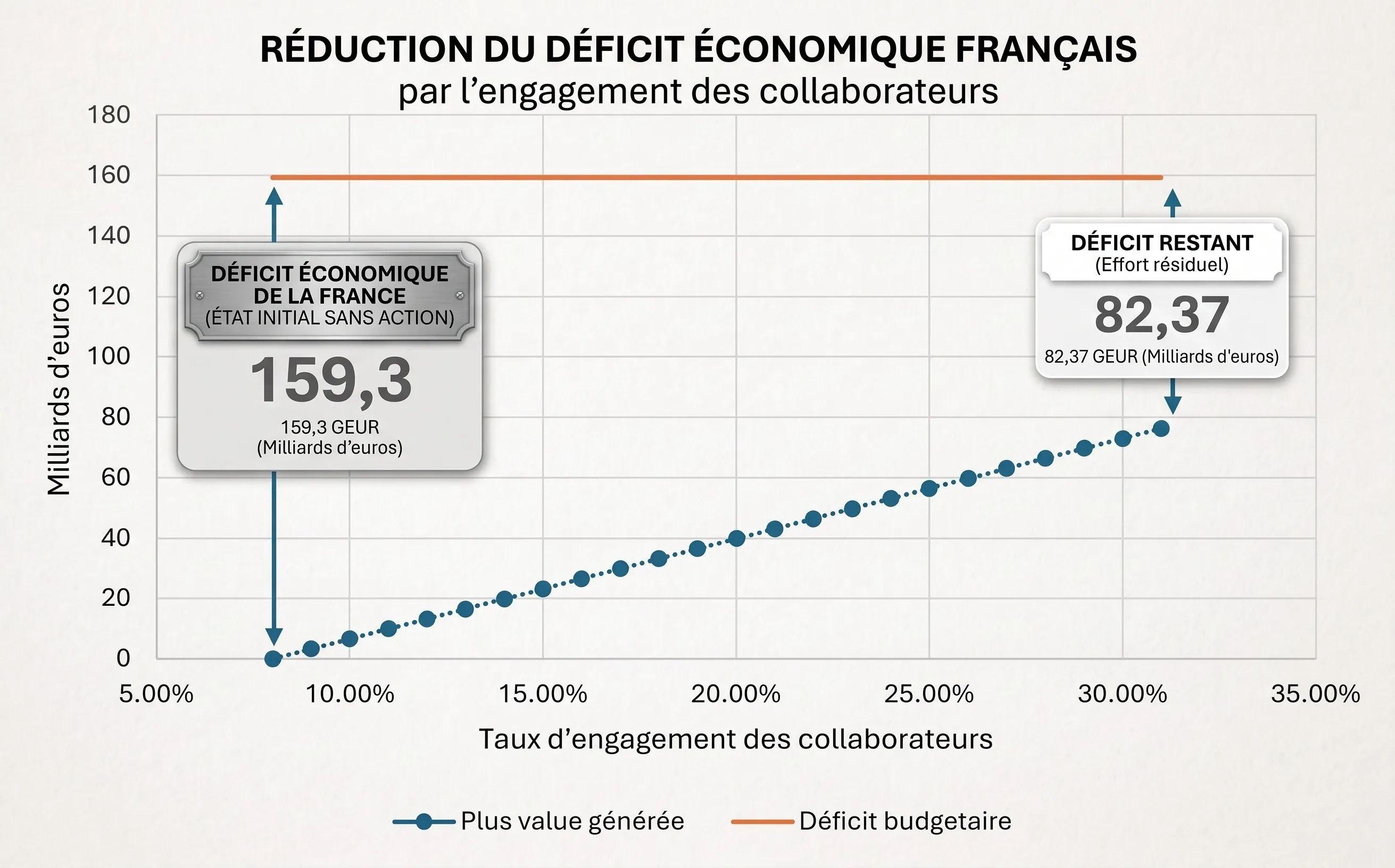
- Applying strict proportionality to the 80% of unengaged workers, the marginal recovery value of a single engagement point equals 0.1125% of GDP (i.e., 9% / 80).
- Transposed to the size of the French economy (roughly €2.95 trillion), this elasticity demonstrates that every additional engagement point equates to €3.319 billion in net annual value creation.
Initiating the organizational reforms necessary to raise France simply to the European average (+4 points) would immediately unlock €13.3 billion annually in the real economy. Embarking on a convergence path toward North American standards would generate a surplus exceeding €70 billion per year.
5. The Operational Lever: Rearming Middle Management
Capturing this dividend and ensuring the viability of the algorithmic shift requires a profound rethink of both state intervention and corporate strategy. The data is definitive: when a direct manager actively supports and guides the use of a new technology, the likelihood of employees experiencing a productive transformation in their work methods multiplies by 8.7 (Gallup, 2026).
The true bottleneck of the economy therefore lies in its middle management. Left unequipped to impose complex systems on teams paralyzed by technostress, these managers must be rearmed.
The State must condition its digitalization support mechanisms on rigorous human adoption engineering. This involves, for example, integrating a cognitive ergonomics assessment when granting public innovation subsidies, or redirecting pooled training funds toward certifications in technological workload management, rather than passive prompt-writing courses. Without detailing the entirety of the necessary governance architectures, the core challenge is to model delegation processes so that technology acts as an extension of cognitive autonomy, rather than an instrument of blind rationalization.
Productive sovereignty in the face of AI will not be decreed through algorithms, but through the ability of companies to treat human adoption as a rigorous science.
References
Bienefeld, N., & Grote, G. (2012). Silence that may kill: When aircrew members don’t speak up and how leaders can ensure they do. Human Factors, 54(4), 581–592. https://doi.org/10.1027/2192-0923/a000021
Bloom, N., Sadun, R., & Van Reenen, J. (2016). Management as a technology? (NBER Working Paper No. 22327). National Bureau of Economic Research. https://doi.org/10.3386/w22327
Challapally, A., Pease, C., Raskar, R., & Chari, P. (2025). The GenAI divide: State of AI in business 2025. MIT Project NANDA. https://mlq.ai/media/quarterly_decks/v0.1_State_of_AI_in_Business_2025_Report.pdf
Gallup. (2026). State of the Global Workplace: 2026 Report. Gallup, Inc. https://www.gallup.com/workplace/349484/state-of-the-global-workplace.aspx
Helmreich, R. L., Merritt, A. C., & Wilhelm, J. A. (1999). The evolution of Crew Resource Management training in commercial aviation. The International Journal of Aviation Psychology, 9(1), 19–32. https://doi.org/10.1207/s15327108ijap0901_2
Yotzov, I., Barrero, J. M., Bloom, N., Bunn, P., Davis, S. J., Foster, K. M., Jalca, A., Meyer, B. H., Mizen, P., Navarrete, M. A., Smietanka, P., Thwaites, G., & Wang, B. Z. (2026). Firm data on AI (NBER Working Paper No. 34836). National Bureau of Economic Research. https://doi.org/10.3386/w34836